Answer
What size spring bars do I need?
Short answer
You need three numbers, and only the first is printed on the packet. Length is your lug width: a 20 mm bar for 20 mm lugs, never the next size up or down. Body diameter is 1.78 to 1.8 mm for most straps and bracelets (the two figures describe the same bar), 1.5 mm or thinner for slim dress cases and narrow strap ends, and 2.5 mm for the "fat" bars on many Seiko divers. Tip diameter has to suit the hole in the lug: 0.7 to 0.9 mm on standard bars, 1.1 mm for the large holes on those divers. Measure the old bar before you order.
On this page (6 sections)
A spring bar has three dimensions that matter: length, tube diameter and tip diameter. Length equals the lug width, the gap where the strap sits, and our lug width finder covers measuring it. Diameter and tips are where orders go wrong, because shops label the same bar differently and some popular watches use a size most straps cannot take.
Two answers circulate. One says every watch takes a standard 1.8 mm bar. The other says dive watches need fat bars for strength. The first is right for most watches and wrong for many Seiko and Citizen divers. The second gets the reason backwards: a fat bar is dictated by the holes in the watch, and on most straps it will not even go through. The figures below are from the published specifications of eleven suppliers.
The sizes side by side
Suppliers publish these figures one listing at a time. Here they are together.
| Bar | Body | Tip | Source |
|---|---|---|---|
| Clasp bar, single flange, short end | 1.0 mm | Not stated | Esslinger |
| Super thin, double flange | 1.2 mm | 0.6 or 0.7 mm, varying by length | Esslinger, 450-piece assortment |
| Extra thin, double flange | 1.3 mm | 0.7 mm | Esslinger |
| Thin, double flange | 1.5 mm | Not stated | Esslinger |
| Regular, double flange | 1.8 mm | 0.8 mm | Esslinger |
| Standard, SST type | 1.78 mm | 0.8 mm (0.9 mm long) | WatchGecko |
| Standard straight, double flange | 1.8 mm | 0.8 mm | Holben's |
| Beco Technic standard (978995) | 1.8 mm | 0.8 mm | Watchia |
| Strap maker's fitted bar | 1.8 mm | About 0.9 mm | Archer Watch Straps |
| Conventional 1.78 bar (SDF-178) | 1.78 mm | 0.7 mm | Long Island Watch |
| Thin body, fat tips | 1.78 to 1.8 mm | 1.1 mm | Long Island Watch, StrapHabit |
| Seiko-style "fat" | 2.5 mm | 1.1 mm | Watch Straps Australia, WatchGecko, ZuluDiver |
Three things stand out. First, the standard size has two names. Esslinger describes its regular bar as "a diameter of 1.8mm (1.78mm)", WatchGecko and Long Island Watch list 1.78 mm, and Holben's and Beco list 1.8 mm. The 0.02 mm between them is less than the play in any strap.
Second, the tips are not standard even when the body is. On a nominal 1.8 mm bar this table has tips of 0.7 mm (Long Island Watch), 0.8 mm (Esslinger, WatchGecko, Holben's, Beco) and about 0.9 mm (Archer). That is why a new bar can sit slightly looser than the original, and why the tip figure is worth checking, not just the body.
Third, the fat bar changes both numbers at once. It is a different part, not a stronger version of the standard one.
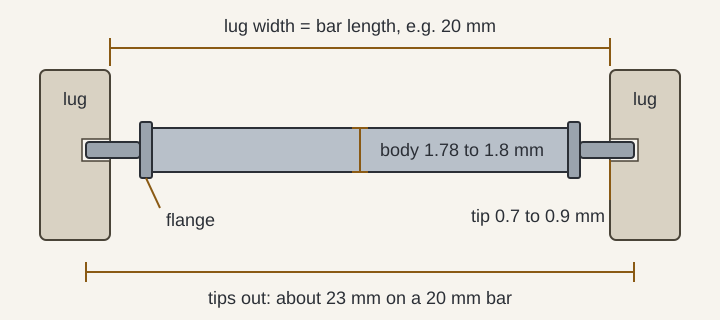
Length is the lug width, and nothing else
Spring bars are sold by the lug width they fit, and Esslinger states the rule plainly: "Sizes are determined by the compressed length of the spring bar." Its dimension tables show what that means in practice. For the regular 1.8 mm bar:
| Lug width | Compressed | Tips out | Beyond the lug width |
|---|---|---|---|
| 18 mm | 17.8 mm | 21.0 mm | 3.0 mm |
| 19 mm | 18.8 mm | 22.1 mm | 3.1 mm |
| 20 mm | 19.8 mm | 23.0 mm | 3.0 mm |
| 21 mm | 20.9 mm | 24.0 mm | 3.0 mm |
| 22 mm | 21.8 mm | 24.9 mm | 2.9 mm |
| 24 mm | 23.8 mm | 27.0 mm | 3.0 mm |
Compressed, every bar is a fraction under its nominal size, so it drops between the lugs. Released, it reaches about 3 mm beyond the lug width, roughly 1.5 mm into each lug if the holes are that deep. Esslinger adds that "sizes are approximate", so treat the tenths as typical.
That arithmetic is why the next size down is not a safe substitute. A 20 mm bar in 21 mm lugs, a common temptation on a watch like the Submariner whose 21 mm width is hard to shop for, reaches 23.0 mm against a 21 mm gap: 2.0 mm of reach instead of 3.0, a third less tip in each hole. The next size up fails the other way: a 22 mm bar compressed is still 21.8 mm and will not fit between 21 mm lugs. Odd widths are stock items, so buy the exact one.
Measure the lug width between the inside faces of the lugs, not across the strap, which is often a little narrower.
Diameter is set by the strap or end link
The body has to pass through the loop of a leather strap, the channel in a rubber one, or the hole bored through a bracelet end link, so the strap is the first constraint on diameter. Holben's sums up the default: "1.8mm is the size that fits the majority of cases", adding that it "may not fit cases or straps with tighter tolerances".
Where the channel or the gap behind the lugs is too tight for a 1.8 mm tube, the 1.5, 1.3 and 1.2 mm bars come in, and Esslinger stocks them from 5 or 6 mm long. A thinner bar than the strap needs is fine provided its tips still fill the lug holes; a thicker one will not go in.
Bracelets are stricter. A solid end link is bored for one diameter, and the bar that came with it is the one to replace like for like. The steel bracelet Russell Jewellers sells for the Seiko SKX007 lists its "spring bar hole dia." as 2.5 mm and ships with fat bars. If you have changed bracelets, measure the bar in the end link now. Our answers on shortening a bracelet and on a bracelet that rattles cover the rest of the hardware.
Tips are set by the lug holes, and Seiko is the exception
Most watches drill lug holes that take a standard tip in the 0.7 to 0.9 mm range shown above. The group that does not is the Japanese dive watch. StrapHabit sums up the split: "The quick-release spring bars standard in our straps feature 0.8mm tips, while Seiko and Citizen divers' spring bars use 1.1mm tips," naming Seiko's Prospex and Citizen's Promaster divers. The Seiko-style bar that goes with those holes, sold as C220FS by Watch Straps Australia, is 2.5 mm thick with 1.1 mm tips and has "no flange".
BARTON's list of Seiko divers that use 2.5 mm "fat boy" bars runs to the SKX007, SKX009, SKX173, SRP777, SNZH55 and SNZF15 at 22 mm, and the SSC017, SKX013 and SRP309 at 20 mm. The SRP777 is the "Turtle" covered on our Prospex Turtle page. Not every Seiko does: StrapHabit believes the SSK001 "is not intended to use the fat tip springbars", so check your own bar before ordering by brand.
Here is the catch the strength argument misses. Long Island Watch puts it directly: "Typically, Seiko spring bars have a barrel diameter of 2.5mm, and they cannot be used with aftermarket straps." StrapHabit agrees that "most fat spring bars can't be installed in standard straps, as they are too thick to fit". Some strap makers do size for them: BARTON tells Seiko owners they can fit their original fat bars to its canvas and leather straps.
That leaves three ways to fit a normal strap to one of these watches:
- A thin bar with fat tips. Long Island Watch and StrapHabit both sell a 1.78 to 1.8 mm body with 1.1 mm tips, which passes through standard straps and fills the large holes. On these watches it is the answer.
- A standard bar in the large holes. StrapHabit says its 0.8 mm tips fit "safely and securely", with "a slight wiggle". That is a seller's judgement, not a test, and the bar above costs about the same.
- A pass-through strap behind the original fat bars, as BARTON suggests for its NATO-style straps.
Going the other way, fat-tipped bars are no use in a watch with standard holes: a 1.1 mm tip will not enter a hole drilled for 0.8 mm.
How to measure the bar you have
The surest order is a copy of the bar already in the watch. With it out on a cloth:
- Body. Caliper across the tube: about 1.8 mm is standard, 1.5 mm or less thin, 2.5 mm Seiko-style fat.
- Tips. Around 0.8 mm is standard; around 1.1 mm means fat lug holes, whatever the body.
- Flange. Double flange bars have a collar at each end for the tool's fork. Seiko-style fat bars have none.
- Length. Compress it and measure. It should read a few tenths under the lug width.
If the original bar is gone, measure the lug width and the lug hole, and match the tip to the hole. Then fit, and pull the strap hard on both sides before wearing it. Our page on a strap that keeps coming off covers the pull test and when to replace bars, and strap and bracelet costs prices them with the tool. The real cost of the wrong size is a drop onto a hard floor.
When this answer stops applying
- The watch has fixed bars. Some watches, the Tudor Pelagos FXD among them, have fixed lug bars instead of spring bars. Nothing here applies, and the strap has to suit the fixed bar, one reason a NATO strap is the usual choice on them.
- The bracelet is integrated. An integrated bracelet often uses its own bar or screw, sold as a spare part by the brand.
- The watch is a dive watch you dive with. The attachment is part of what ISO 6425 tests. Use the maker's bars, or the same body and tip.
- The watch is vintage. The old bar is the only reliable guide. Never open out a lug hole to suit a bar.
For everything else, the answer fits in one order line: bars as long as the lug width, a 1.78 to 1.8 mm body unless the strap or end link calls for thinner or fat, and tips that fill the holes, which on a Seiko or Citizen diver means 1.1 mm. Choosing the strap that goes on them is a separate decision, set out in our guide to straps and bracelets and our comparison of nylon, leather and metal.
Common follow-up questions
Is 1.78 mm the same as 1.8 mm?
Yes. They are two labels for the standard spring bar. Esslinger lists its regular bar as "1.8mm (1.78mm)".
Can I use 20 mm spring bars on a 21 mm watch?
They will fit, but they hold less. Esslinger's 20 mm bar reaches 23.0 mm with its tips out, 2.0 mm beyond a 21 mm gap instead of the 3.0 mm a 21 mm bar gives, so each tip sits a third less deep. A 22 mm bar will not go in at all. Buy 21 mm.
Sources and further reading
- Esslinger, Watch Band Pin 1.80mm Regular Double Flanged Stainless Steel Spring Bars (dimension table, parts 82.2068 to 82.2458).
- Esslinger, Stainless Steel Double Flange Spring Bar Assortment 20-26mm, 1.8mm diameter ("1.8mm (1.78mm)").
- Esslinger, Watch Band Pin 1.30mm Extra Thin Double Flanged Spring Bars (dimension table) and 1.50mm Thin Double Flanged Spring Bars.
- Esslinger, Watch Band Pins 1.20mm Super Thin Double Flanged Spring Bar Assortment, 450 pieces (dimension table).
- Esslinger, Steel Short Tip Single Flange Spring Bars 1.0mm Thick.
- WatchGecko, Standard Diameter Replacement Watch Strap Spring Bars, and 2.5mm Diameter Seiko Style "Fat" Spring Bar.
- Holben's Fine Watch Bands, Stainless Steel Spring Bars, 1.8mm Standard.
- Watchia, Standard spring bars Beco Technic 978995, 1.8 mm.
- Archer Watch Straps help centre, Spring bar dimensions.
- Long Island Watch, Pair of 22mm Spring Bars with Fat Seiko Tips, SB-02.
- StrapHabit, Thin Spring Bars for Seiko and Citizen Fat Lug Holes (product text and replies).
- Watch Straps Australia, C220FS Seiko style 22mm fat spring bar set; ZuluDiver, "Fat" 2.5mm Seiko Style Spring Bars.
- BARTON Watch Bands, "Seiko Diver Options!", 21 August 2017.
- Russell Jewellers, Endmill watch band for Seiko SKX007 (spring bar hole diameter).
Last reviewed 14 October 2026. Spotted an error? Tell us and we will fix it in public.